
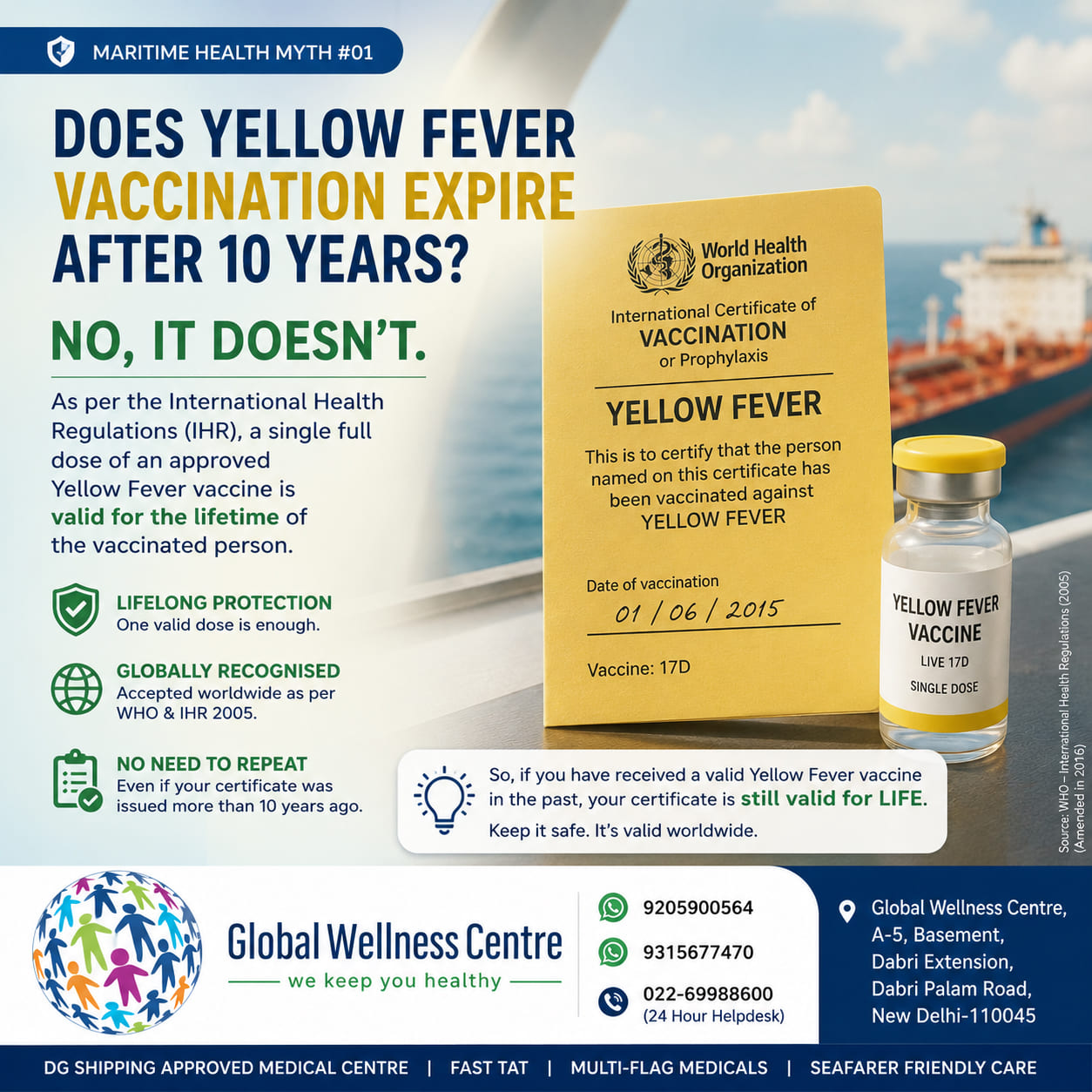
Does Yellow Fever Vaccination Expire After 10 Years
For many years, travellers and seafarers were told that the *Yellow Fever vaccination was valid for 10 years*.
That rule has changed.
The current rule
Under the *International Health Regulations (IHR), a valid Yellow Fever vaccination certificate is now considered **valid for the lifetime of the vaccinated person*.
The change became effective internationally on *11 July 2016*.
This means that if a seafarer received a properly documented Yellow Fever vaccination in the past, they do *not routinely need another dose simply because 10 years have passed*.
Example
A seafarer vaccinated in 2010 may still have a certificate showing the old 10-year validity period.
That does not automatically mean the vaccination needs to be repeated.
Why is this important for seafarers and shipping companies?
Incorrect information can lead to:
- unnecessary repeat vaccination
- additional cost
- confusion during pre-joining documentation
- avoidable delays before joining a vessel
For a *first-time Yellow Fever vaccination, remember that the international certificate generally becomes valid **10 days after vaccination*. Pre-joining vaccination requirements should therefore be checked early.
One important distinction
Lifetime certificate validity does not mean that a booster can never be medically advised.
In certain special clinical situations, a doctor may recommend another dose based on the person's health condition and exposure risk.
But the old practice of automatically repeating Yellow Fever vaccination every 10 years is no longer the international rule.
Maritime Health Myth
❌ *Myth:* Yellow Fever vaccination expires after 10 years.
✅ *Fact:* A valid Yellow Fever vaccination certificate is recognised under the IHR for the *lifetime of the vaccinated person*.
Global Wellness Centre*
DG Shipping Approved Medical Centre
A-5, Basement, Dabri Extension, Dabri Palam Road, New Delhi – 110045
Appointments: *9205900564 | 9315677470*
24-Hour Helpdesk: *022-69988600*
*We keep you healthy.*
Reference: World Health Organization – International Health Regulations (2005), Annex 7.